


Feudal Society Vol 1 And Vol 2
Publisher: Routledge and Kegan Paul
Format: Paperback
ISBN: none
There are books that explain history, and then there are books that quietly rearrange how you think history works in the first place. Marc Bloch’s Feudal Society belongs very firmly in the second category. This is not a jaunty tour of knights, castles and the occasional tournament. It is a deep, patient excavation of how medieval Europe actually functioned—less shining armour, more obligations, loyalties, misunderstandings and people trying to make sense of a world without a central instruction manual.
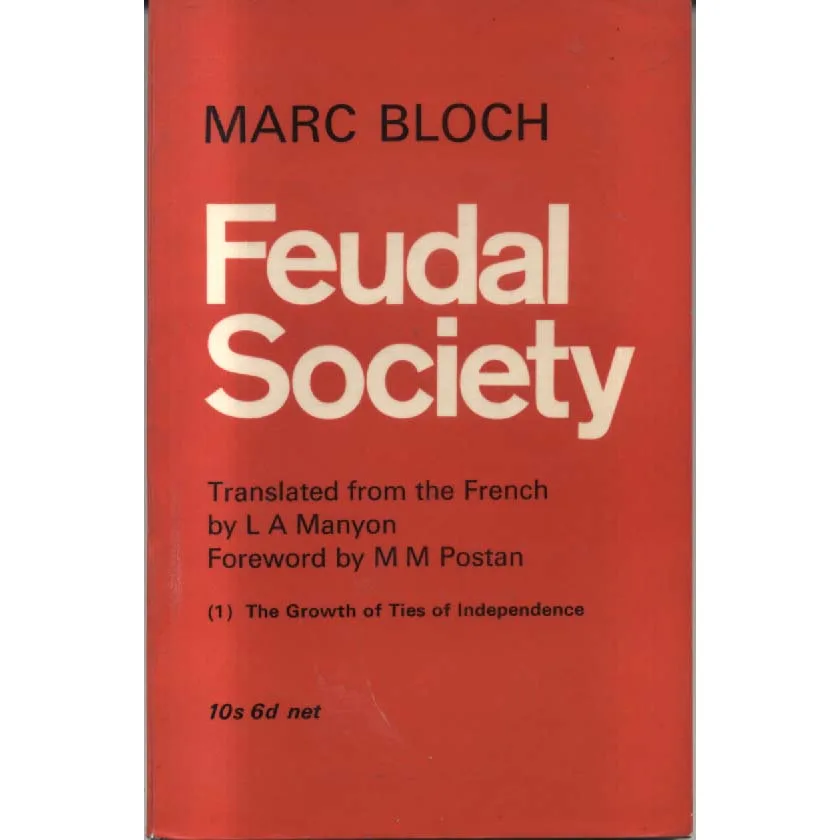
Feudal Society, Vol 1 & Vol 2 (1965) by Marc Bloch arrives here as a complete two-volume set, which is fitting, because the Middle Ages themselves were not inclined to fit neatly into a single book. Bloch, a founding figure of modern historical thinking, does not simply describe feudalism as a system; he takes it apart and shows you the wiring. Land, power, personal bonds, social structures, law, custom—all are examined with a kind of calm, forensic curiosity that makes you realise how much of what you thought you knew was really just a collection of dramatic images and half-remembered school lessons.
Volume 1: The Growth of Ties of Dependence explores how relationships—between lords and vassals, landholders and tenants—formed the backbone of medieval life. This is a world where power is personal, authority is negotiated, and loyalty is both essential and, at times, inconveniently flexible. There are no clean hierarchies here, just a dense web of obligations that everyone understands until they don’t.
Volume 2: Social Classes and Political Organisation moves outward into the broader structure of society. Classes emerge, institutions wobble into existence, political authority takes shape in ways that are anything but straightforward. Kings rule, certainly, but often with the uneasy awareness that much of their kingdom is busy doing its own thing. Order exists, but it is negotiated, improvised and occasionally ignored.
What makes Bloch so compelling—beyond the sheer intelligence—is his refusal to treat the medieval world as primitive or quaint. This is not a dark age populated by simple people waiting for modernity to rescue them. It is a complex, adaptive society with its own logic, its own rhythms, and its own solutions to problems that feel surprisingly familiar: who owns what, who owes what, and who gets to decide. If anything, the irony is that the so-called “feudal system” was not a tidy system at all, but a sprawling, evolving set of practices that historians have spent centuries trying to label after the fact.
There is also a quiet grandeur to the project. Bloch is not interested in the occasional colourful anecdote (though there are plenty lurking in the margins). He is interested in structure, mentality, and the long-term patterns that shape societies. It is history as analysis rather than spectacle, which makes it all the more rewarding for readers willing to lean in and let the argument unfold.
For readers of Crappy Old Books, this is exactly the sort of acquisition that signals serious intent. Two solid volumes, faintly intimidating, quietly authoritative—perfect for a shelf that says, “Yes, I could explain medieval social organisation if pressed, though I would prefer not to be.” It is the kind of work that rewards dipping into, returning to, and occasionally staring at while wondering how medieval people kept track of anything at all.
Condition: Good, which is impressive given the conceptual weight involved. A complete two-volume set of one of the twentieth century’s great works of historical scholarship—less a casual read than a long, thoughtful conversation with the Middle Ages, conducted across several hundred pages and a great many centuries.
Keep browsing: See more History books Other books by March Boch
